

HabiTidy, A home organisation app for beginners
Caring for Your Space from Home and Mind
Project type: End-to-end app + interactive mini game + branding
Role: Final Year Project Leader, UI/UX Designer
Industry: Home Organising, Mental Health
Tools: Figma, FigJam, Html/Css/Javascript, Adobe Kits, Capcut
Duration: Sep 2024 - May 2025
*Send me request and I'll approve it ASAP!*


Introduction
The Users
HK people who feel the emotional weight of a disorganized space. They want to improve their home environment and reduce daily stress, but they lack the professional skills, motivation, or a clear system to make it happen.

The Problem
In Hong Kong's compact urban environment, this struggle is amplified. According to the '2021 Population Census', the median living space per person is only about 172 square feet. In such confined areas, clutter isn't just a physical issue—it directly impacts mental well-being and makes relaxation at home difficult.
The Product
This is where HabiTidy comes in. It's a beginner-friendly home organization app that transforms the daunting task of decluttering into manageable, guided habits. Through professional guidance and interactive game, we help users build core organising routines and gradually create a tidy, low-stress living space.
The business goal
We wanted to enhance the home organisation quality of users by making HabiTidy a part of users' daily routines.

How might we integrate HabiTidy
with users’ daily routines?
To make tidying a natural part of life...
Before building habits, we needed to understand what was breaking them in the first place. So, we went straight to the source
—through interviews and a hands-on workshop—
to learn why people struggle to maintain an organized home.
What We Learned from Real People
Talking to 10 interviewees (which are our target users) and hosting a workshop with a professional organiser revealed three common roadblocks:
1. No "home" for things
Items don’t get put back because there’s no clear place for them.
2. No regular clearing ritual
Unnecessary items pile up because there’s no habit of letting go.
3. No clear method

People want to tidy but don’t know where to start or how to systemise.


The Proposed Solution
We designed HabiTidy not as a one-time fix, but as a friendly guide that integrates into daily life. It tackles the core problems we discovered with three key features:
🗂️ The Smart Item List
To solve the "no regular clearing ritual," we created a dynamic inventory that does the remembering for users.

-
Categorised View: Items are automatically sorted into "Use within a year" and "Keep over a year."
-
Smart Prompts: As items near the end of their useful life, the app gently nudges them to decide: Keep, Donate, or Discard?
💡 Return Items to Place
To address "no 'home' for things," we turned tidying into a focused, rewarding daily mission.


-
Engaging Timer: A countdown with escalating music turns cleaning into a fun, motivating challenge.
-
Visual Payoff: After tidying, use a slider to see a before-and-after comparison of their space, providing instant visual gratification.
-
Mood Tracking: Log their mood post-task to see the direct emotional benefit of an organized environment.
Unexpected Issues Occured

.png)
What didn't work?
Our first prototype was full of good intentions, but real users quickly showed us where our assumptions didn't match their reality. Three critical pieces of feedback reshaped our direction:
-
Without clear organising examples, the photo feature felt redundant. The interface also lacked rewards, making tasks feel like obligations rather than engaging habits.
-
Intended to motivate, the timer instead created stress and a sense of being scolded, which contradicted our goal of reducing cleaning anxiety.
-
Several users found the initial app experience a bit boring, highlighting a need for more delight and interactivity in the core flow.
What did work?
-
Users loved the before-and-after comparison slider. Seeing their progress visually provided an instant sense of accomplishment and motivation.
-
For those who struggle with letting go, the reminder feature was a hit. One user noted, “It's genuinely useful—it reminds me to discard items I'd even forgotten I owned.”
-
Allowing users to select a specific zone (like “bedroom” or “kitchen”) for the “Return Items” task made the chore feel manageable and clearly defined, which several users appreciated.
.png)
Helping users feel
Guided, Motivated & Engaged
Priority Revisions
Since users lacked motivation to log items and the professional knowledge to organise effectively, our priority became making the experience easier to adopt and more rewarding to use.


Build a Reward Mechanism → Motivated
We transformed tedious tracking into a rewarding journey. Users now earn coins by completing daily missions (like logging one item). These coins can be redeemed for real-world discounts on storage tools through our partner, IKEA.
-
Why it works: It turns habit-building into tangible progress, motivating users to consistently engage with the app and build their item database effortlessly.


Original

Now

Mission Page
Add Gamification → Interested
We built a playable, browser-based mini-game (using HTML, CSS & JavaScript) where users learn by doing. Players first select their real-life storage tools (e.g., a drawer wardrobe), then organise a simulated messy space.
-
Interactive Feedback: Items shake and sound an error if placed incorrectly.
-
Skill Tutorial: After organising, the game provides tailored tips based on professional methods.
-
Why it works: It makes learning organisational skills fun and practical, directly applicable to their home.

Original

Now

Game Page
*The video above is a Figma simulation.
For a hands-on experience with the code-based interactive version,
feel free to reach out to me!*

Refine "Return Items to Place" → Guided
We transformed the overwhelming timer into a guided, step-by-step process. To add warmth and clarity, we introduced a friendly Declutter Elf mascot.
-
How it works: The Elf acts as a companion, breaking down tasks into simple steps through conversational cues.
-
Why it works: It provides professional guidance without lengthy text, creating a sense of support and making the process feel manageable.
Original

Now
Declutter Record Page

Enhance the Smart Item List → Managed
We expanded the Smart Prompt system to reflect real life. Now, when an item's reminder appears, users can choose: Keep, Recycle, Discard, or Mark as Lost.
-
How it works: "Lost" items move to a separate list. Once found, users can easily resolve their status.
-
Why it works: It acknowledges that items go missing and provides a simple system to manage them, reducing user frustration.

Original

Now

Lost Item List Page
Finalising the System
To finalise our design...
While the core features established a foundation for daily habit-building, our user research revealed deeper needs that shape a truly complete system. This final phase introduces innovative features that address the "what next?"
—helping users act on their decisions, find ongoing inspiration, and receive truly personalised guidance.
The Final Round of Usability Test
To ensure our solutions were not only user-friendly but also professionally sound, we consulted and tested our prototype with
3 certified local professional organisers. Their involvement helped us solidify three key insights:
1. The Problem Doesn’t End at “Toss It”

Many users didn’t know how to responsibly dispose of items, whether to recycle, donate, or discard them.
2. Knowledge Must Be Effortless to Find

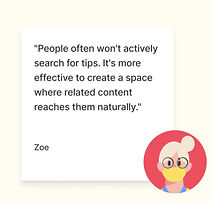
It would be better if users could browse organising tips casually and naturally,
not just through rigid tutorials.
3. “Tidy” is a Personal Standard

Everyone defines “organised” differently. For some, it’s about functionality;
for others, it’s space efficiency, visual tidiness, or aesthetics.
There’s no one-size-fits-all standard.
The Final Solution
To meet these needs, we introduced three final features and
tested them with the organisers again.

Recyclable Location Page
To support eco-friendly habits, we added a “Recycle Locations” shortcut on the Home Page.
-
How it works: Users can find nearby recycling spots, along with accepted items, opening hours, and addresses.
-
Seamless Flow: When users select “Recycle” in the Smart Item List, they are directed here—creating a clear path from decision to action.
-
Why it matters: It bridges the gap between wanting to recycle and knowing how, building responsible habits effortlessly.
Original


Now

Recyclable Location Page
Explore Page
To make learning enjoyable, we created an Explore Page—a community space where certified organisers share tips, much like Instagram for home organising.
-
Quality Control: Posters must hold at least a JALO Level 1 Practical Organiser certification.
-
Why it matters: Users can scroll through professional, visually engaging content, discovering new ideas in a natural and inspiring way.
Original

Now

Explore Page
Intro: Organising MBTI
Since organising is personal, we introduced an Organising MBTI feature.
-
How it works: Based on a short assessment, users discover their organising personality and receive tailored strategies that match their style and weaknesses.
-
Why it matters: It moves away from one-size-fits-all advice, giving users a customised plan that feels relevant and achievable.

Original

Now

Introduction Page
*Appears when users first open the app*
So… What’s Next?
1. Personalising the Declutter Guide
Future Development
Given this was an eight-month final year project, HabiTidy’s potential extends beyond our current prototype. If development were to continue, here is our roadmap for further exploration and expansion.

Our current “Declutter Record” tutorial offers a comprehensive, step-by-step guide for organising a bedroom. In the future, we’d introduce customisable workflows, allowing users to select and sequence only the steps they need, skipping irrelevant processes for a faster, more tailored experience.
2. Expanding the “Unwanted Items” Ecosystem
While our prototype focuses on the “Recycle” pathway, a complete system should also support reselling. We plan to integrate a second-hand marketplace feature, enabling users to easily list and sell unwanted items in good condition—moving beyond disposal to conscious redistribution.
3. Activating Commercial Partnerships
To make rewards truly meaningful, we intend to establish commercial partnerships with home and storage brands like Muji, IKEA, and Daiso.
Users would then be able to redeem coins earned in the Mission Page for real discounts, directly linking habit-building to tangible, real-world benefits.
4. Developing the Educational Game Series
Our current mini-game uses a wardrobe as its introductory level, teaching basic clothing organisation. Inspired by the KonMari Method™, future levels would follow its proven tidying order—Clothes, Books, Papers, Komono (miscellaneous items), and Sentimental—gradually increasing in complexity to build user confidence and skill in a structured, supportive way.
What I learned
The most significant lesson from this project was to never begin a design based on my own assumptions.
I initially hypothesised a direct link between consumer habits and organising habits. However, interviews and questionnaires revealed that frequent shopping does not necessarily lead to a disorganised home. Confronted with this flawed premise, I felt momentarily lost and questioned my preparatory research.
In hindsight, this “mistake” was invaluable. Firsthand conversations taught me something no paper could: there is no universal correlation between two. This pivotal insight reframed the entire project, steering our focus toward the real, shared struggles of disorganised individuals.
We hosted a workshop with professional organiser Mr. Wong, where participants tidied a simulated chaotic space. This experience revealed a second crucial truth: even expert methodology is not one-size-fits-all. Everyone’s living context and needs are unique.
These lessons fundamentally shaped HabiTidy’s core philosophy: to offer diverse, adaptable organising strategies rather than a single prescribed solution. True design begins not with what we assume, but with what we discover.


Workshop conducted with professional organiser
Participants folding clothes with their own mothod
